
Description
JOHN MAUS lives in his birthplace of Austin, Minnesota. Whilst working towards his PhD in Political Science he also composes music that taps into melancholic fantasy and affirms that we are all truly alive. Questing synthesisers, tensely strung bass lines and chasing drum machines providing the perfect backdrop for Johns deeply resonant reverb-drenched vocal.
Born in the decade of synth pop and sharing his birthday with George Frideric Handel, John started making music when Nirvana posters went up on every teenagers wall. Its this curious conflux of influences that partially helps to describe Johns music. Its a world where the Germs jam with Jerry Goldsmith, Cabaret Voltaire relocate to Eternia and Josquin des Prez writes a new score for RoboCop. The confrontation of punk, the fleeting poignancy of 80s movie soundtracks, the insistent pulse of Moroder and the spirituality of Medieval and Baroque music all find salvation in John Maus.
After a spell working alongside Ariel Pink (whom Maus met whilst studying at Cal Arts in Los Angeles) and Gary War in Haunted Graffiti, 2006 saw the release of Johns debut album proper through Upset The Rhythm. It was a record permeated with aching memories; a perfect testimony to lost romance and longing. Its awe-inspired follow-up Love Is Real (released on UTR, 2007) proved a more cohesive listen in terms of focus and emotional depth. Like an apocalyptic journey through the nostalgic streets of a common hometown, deep into the recesses of the human heart, Love Is Real still stands out as an impressive whole. Both albums made an impact which grew and grew during some quieter academic years for Maus in the Hawaiian heat, before he returned last year to the heavy snows of the Midwest to finish album number three, We Must Become The Pitiless Censors Of Ourselves.
We Must Become The Pitiless Censors Of Ourselves breaks new ground for Maus. The shirt pulling and air punching of his impassioned live performance is finally captured in all its frenzied appeal alongside a tender inner space. After stretching muscles with opener Streetlight, arpeggiators bubble up to new levels with Quantum Leap, a song full of dead zones, glancing slaps and oscillating solos. Heart to heart, mind to mind, we are the ones who seem to travel through time, intones Maus resolutely through the mist. Johns lyrics are as likely to touch upon themes of Cronenberg gore just as much as the musings of Jacques Rancière. Its this no-brow approach that makes things interesting, casting Maus as a savant and allowing his music to startle us in ways whereby we open up to the unimaginable.
Johns preoccupation with truth, love and eternity are perfectly suited to this treatment as seen with And The Rain and the softly cascading Keep Pushing On .The songs are devastatingly catchy, saturated with keyboards and overflowing with Maus allegorical summons. The hypnotic fugue We Can Break Through treads new territories into minimalism for Maus, seeing the phrase Break through this repeated almost like a mind control procedure scored by Bach and Suicide.
Pitiless Censors as an album displays a more delicate touch than its predecessors. Hey Moon is Johns first duet, performed with Molly Nilsson, who originally wrote the song. Its a serene and elegiac song, which subtly weaves an impression of nocturnal loneliness
and romantic dreams. Closing track Believer is equally evocative with its bells, choral soaring and echoing sentiment. Of course, a John Maus album wouldnt be a John Maus album without the same anthemic genius and dark humour that weve seen previously with songs like Maniac and Rights For Gays and this new album finds its succour in Cop Killer. The eerie waltz-time offspring of Body Counts controversial 90s protest track, Cop Killer is dystopian, bleak and ridiculous and in short, classic Maus.
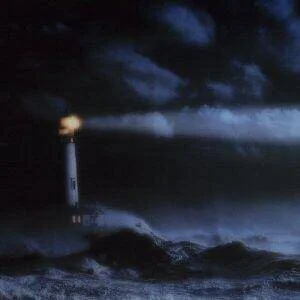
Unlike the last two albums, Pitiless Censors looks towards the future in all its absurdity. Its a record where promise takes the lead for the first time, providing a counterpoint to Johns default existential calling. The cover of Pitiless Censors depicts an airbrushed lighthouse, thrashed by wave after wave, bringing to mind Becketts quote Unfathomable mind: now beacon, now sea. The everyday realm where our lives seem both familiar and equally strange is where John Maus resides. His surreal touch is disarming, opening our eyes to the reality outside the four walls. Perhaps were all like the human being who finds himself in the locker in Head For The Country in that if we surprise ourselves and open the door we can let the light in despite the storm.
Green vinyl.



Reviews
There are no reviews yet.