Description
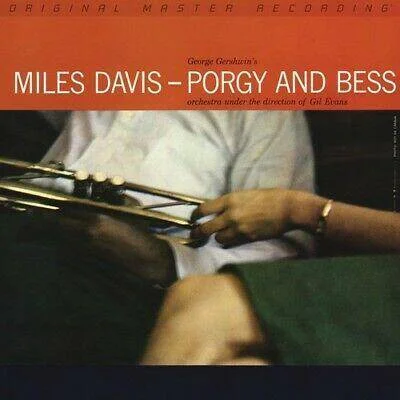
If a more significant, influential, and lasting result of a creative musical partnership exists than that of Miles Davis and Gil Evans Porgy and Bess, society hasnt seen it. Its impossible to overstate the importance of the pairs collaboration on the landmark 1959 update of George Gershwins opera. Transcending genre, time, and place, the profound statement finds Evans and Davis implementing modal approaches in a mainstream context and advancing jazz idioms that would become the foundation of the forms still-classic era. And thats saying nothing of the soulful playing legendary performances by Davis first great quintet that can now be heard in pristine detail courtesy of this definitive digital edition.
Mastered from the original tapes and strictly limited to 3,000 numbered copies, Porgy and Bess attains previously unheard degrees of clarity, openness, immediacy, and depth on Mobile Fidelitys hybrid SACD. Here, the arrangements unfold amidst practically limitless soundstages and burst with multi-dimensional images. Separation between instruments allows you to locate individual band members and trace the decay of the notes. Davis iconic solo passages take on borderline-surreal qualities of realism and shape. The magisterial scope of the Evans-conducted orchestra emerges with room-filling bloom, color, and dynamics.
While difficult to pinpoint its single-best strength, Mobile Fidelitys reissue gives reference-level credence to what may remain the albums most crucial aspect: tone. Based not on chords but on scales and feeling, Porgy and Bess teems with emotions and possibilities characteristics conveyed by the nuances, timbre, and temper delivered by the array of horns, woodwinds, basses, and percussion involved. Whether the combination of Bill Barbers tuba in unison with Paul Chambers bass during Buzzard Song, Davis improvisational flights on It Aint Necessarily So, or the doubling up on alto flutes on several compositions, never before have they been experienced with such richness, roundness, and palpability.
Just as identifying singular sonic highlights proves virtually unfeasible, so does underlining which songs feature the most memorable exchanges, melodies, and scoring. Davis and Evans adaptation of Porgy and Bess remains of a piece, an American touchstone, a recording that immediately separated itself from the multiple other versions released during the same period and continues to make waves decades after its creation, assuming a place in the historical canon alongside collaborative masterworks by Duke Ellington/Billy Strayhorn and Frank Sinatra/Nelson Riddle.
Defined by Davis biographer Jack Chambers as a new score, with its own integrity, order, and action, Porgy and Bess has been identified by nearly every major outlet and expert as a must-have album. Davis phrasing alone cements the effort with a genius quality. As Brian Cook and Richard Morton explain in The Penguin Guide to Jazz: Prayer is an astounding tour de force, harmonically suspended, and with Miles most extraordinarily recorded solo to date punctuated by agonized screams and shouts, whether of affirmation or suffering it isnt easy to judge. Miles was not in good physical condition during the making of the record, which perhaps explains the twisting intensity, the bent notes and slurs which seem to express some inner pain. Then theres the immortal rendition of Summertime, the epitome of calm, understatement, and beauty.
At once sweet and spiritual, sure and steady, graceful and exuberant, happy and poignant, Porgy and Bess is a phenomenal jazz dance that has never been equaled and likely, never will. Hear it as Davis, Evans, and company intended.
Reviews
There are no reviews yet.